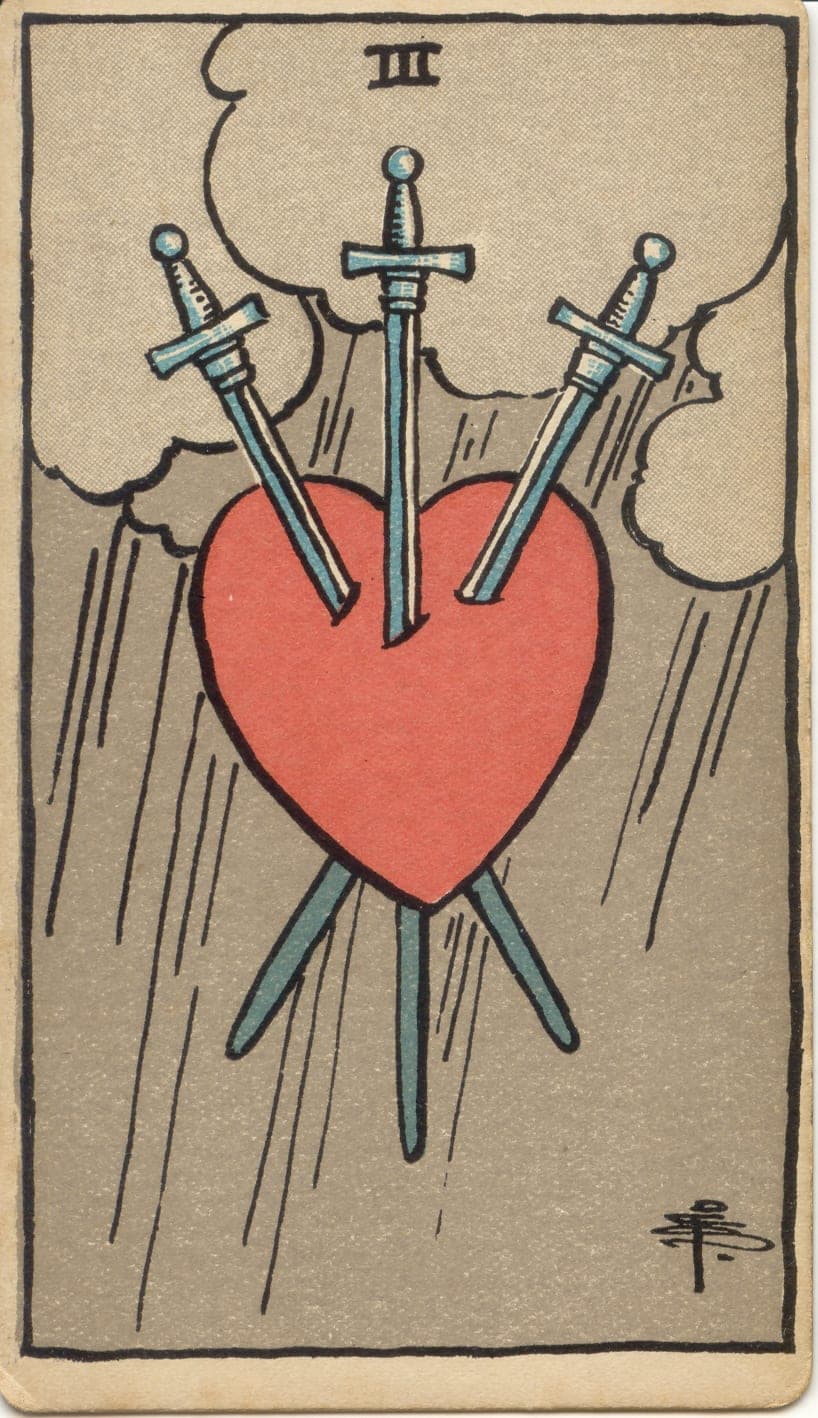
A heart pierced by three swords under falling rain: a card of separation, absence and rupture.
Card art by Pamela Colman Smith (1909), public domain
Upright
Yes / No: No
The Three of Swords speaks of separation in its many forms: something taken away, absence, delay, division, a break, or things scattering apart. Waite adds that it also carries whatever the picture plainly suggests, which he thought too obvious to spell out. Where is a parting or rift asking for your attention?
separation
absence
delay
division
rupture
scattering
Reversed
Yes / No: No
Reversed, the card describes a mind pulled in many directions: mistakes, loss, distraction, disorder and confusion. Instead of a single clean break, things become muddled. Slowing down and sorting out the pieces may help you see the situation more clearly.
confusion
error
disorder
loss
distraction
Love & relationships
Upright, the Three of Swords reflects hurt in a connection: a parting, a painful absence, a delay or a rift that is hard to ignore. Its image of a pierced heart speaks plainly of grief. Acknowledge what needs acknowledging, treat your own feelings gently, and reach for support or an honest conversation rather than carrying the ache alone.
Reversed, the Three of Swords can describe a muddled stretch, when mixed signals, small mistakes and distraction make it hard to tell what is really happening in the connection. Rather than one clean break, things may feel scattered. Taking one step at a time, and separating fact from worry, may bring the picture back into focus.
The image
Few pictures in the suit are plainer: a heart with three swords driven through it, set against heavy cloud and falling rain. Waite describes the scene in a single short line.
Symbolism
The heart is the obvious center of the design, and Waite felt its meaning needed no long explanation. The three blades suggest something divided or cut apart, in line with his list of removal, rupture and dispersion. The storm adds a heavy mood, and the suit itself, which Waite saw as seldom gentle, frames this as a card of hardship.
In a reading
Upright, the Three asks you to look at an absence, a delay or a parting, and at how you want to meet it. Reversed, it points to the confusion and small errors that may be adding to a sense of disorder, and to what might restore a little order.
The yes / no answer is our editorial reading of the card’s overall tone, not a prediction.
For self-reflection and personal insight. Not a prediction and not a substitute for professional medical, legal, financial or mental-health advice.