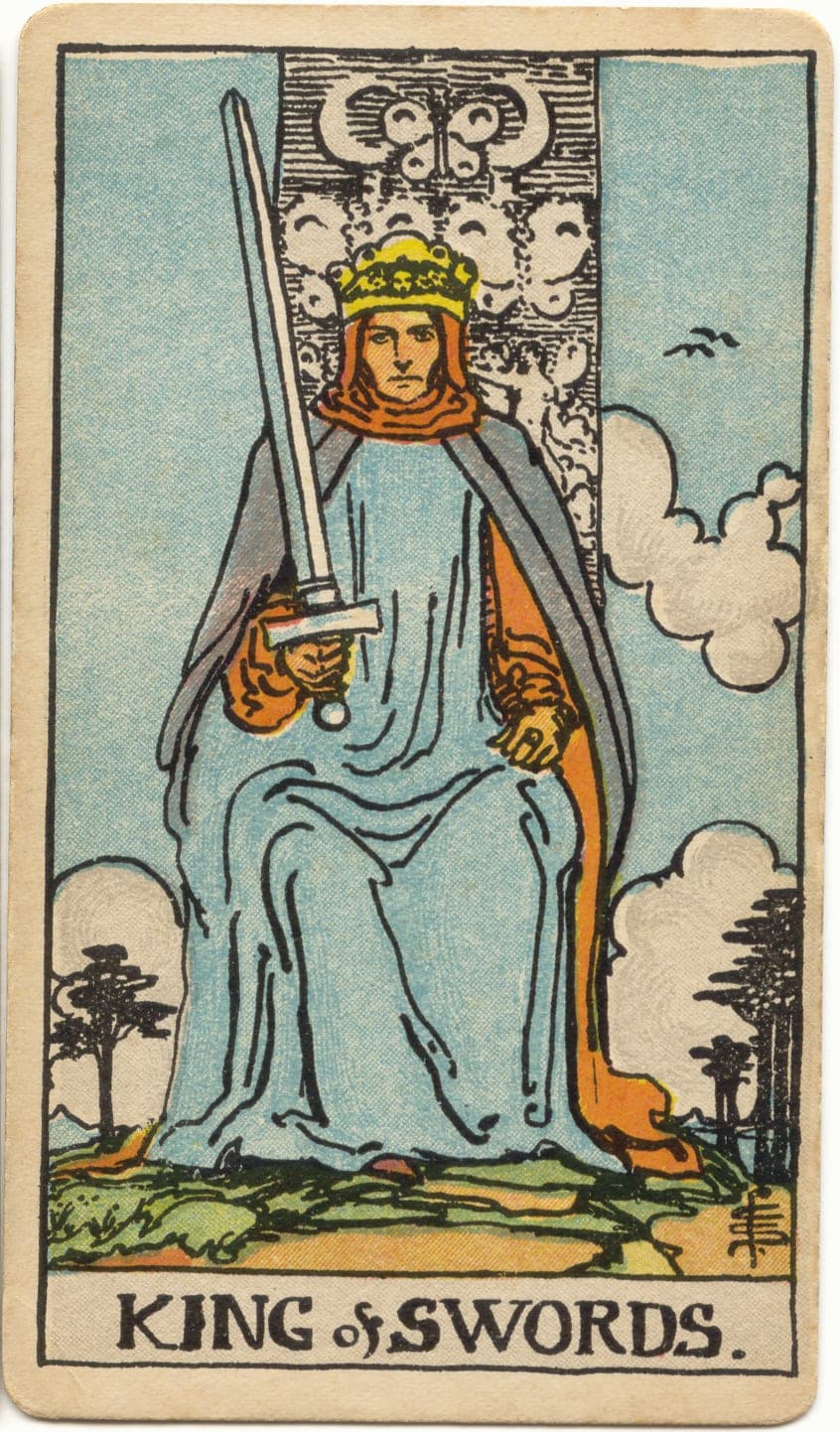
A king sits in judgment with a drawn sword: a card of authority, command, law and keen intelligence.
Card art by Pamela Colman Smith (1909), public domain
Upright
Yes / No: Yes
In Waite's reading, the King of Swords stands for everything that springs from the idea of judgment: power, command and authority, a keen and combative intellect, the law, and official or state roles. Firm, fair decisions may be needed, along with a careful look at how you exercise the authority you hold.
judgment
authority
command
law
combative intellect
public office
Reversed
Yes / No: No
In reverse, Waite lists cruelty, perversity, savagery, treachery and harmful intent: the King's authority turned toward harm instead of fairness. How is power being used in the situation, by you or by others, and does it still serve justice?
cruelty
perversity
savagery
treachery
ill intent
Love & relationships
Upright, the King of Swords describes a connection guided by the head as much as the heart: clear thinking, firm principles and a strong sense of fairness. Conversations may be direct and decisions carefully reasoned, sometimes at the cost of warmth. Are honesty and fairness matched by enough tenderness for both of you to feel heard?
Reversed, the King of Swords suggests power in a relationship being used to control, wound or deceive rather than to treat someone fairly. Cruelty and manipulation are signs to take seriously, not to explain away. Is the bond safe and respectful? If not, set firm boundaries or seek trusted support.
The image
The King sits in judgment with his drawn sword, the emblem of his suit, in hand. Waite notes that the figure naturally recalls the familiar image of Justice among the major cards.
Symbolism
Waite allows that the King may represent the virtue of justice, but he sees him more as the power over life and death that comes with high office. The bare blade shows that this power is active and ready for use. As the highest court card of the suit, he gathers its themes of decision and command into one ruling figure.
In a reading
Drawn upright, the King brings a decision into focus, or a question of fairness, or your relationship to rules and authority. Reversed, he asks whether power is being used harshly or dishonestly, and what fair use of it would look like.
The yes / no answer is our editorial reading of the card’s overall tone, not a prediction.
For self-reflection and personal insight. Not a prediction and not a substitute for professional medical, legal, financial or mental-health advice.