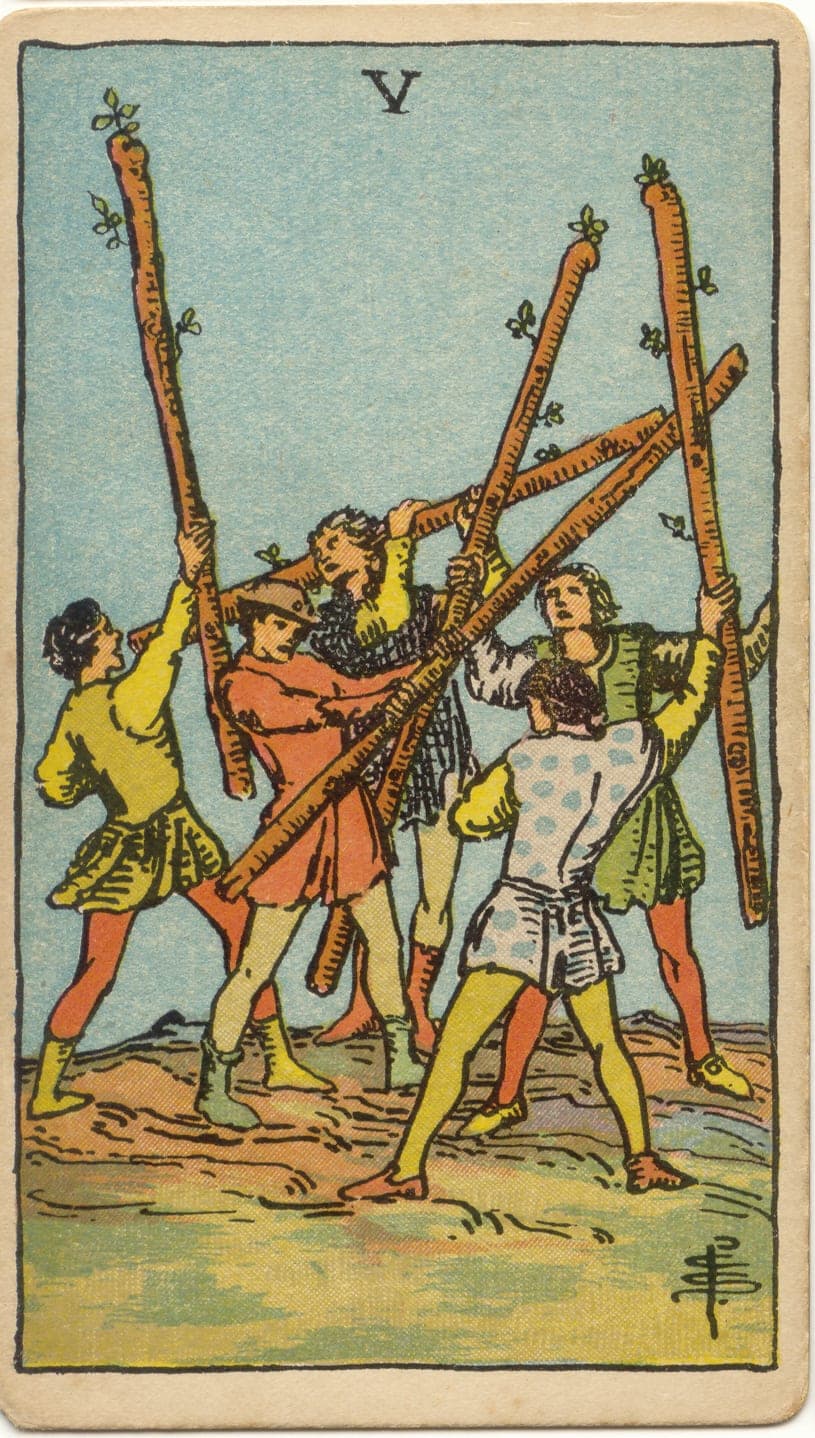
Young men clash with staves in a fight that is half game: a card of rivalry and striving and, reversed, of real disputes.
Card art by Pamela Colman Smith (1909), public domain
Upright
Yes / No: Maybe
The Five of Wands describes a contest that is partly play: imitation, a mock fight, the jostling of rivals. Waite also connects it with the serious competition of chasing wealth and fortune, which is why some older readings tie it to gain and plenty. Which of your struggles are real, and which are just sparring?
mock battle
imitation
fierce competition
striving for fortune
gain
Reversed
Yes / No: No
Reversed, the tone sharpens. Waite lists litigation, disputes, trickery and contradiction: conflicts that have stopped being a game. Where has disagreement turned bitter or deceptive, and what would honest clarity look like for you?
legal disputes
arguments
trickery
contradiction
Love & relationships
Upright, the Five of Wands suggests playful friction or competing wishes between two people, a back-and-forth that may feel lively rather than hostile. It can also mean rivalry for someone's attention, or two strong personalities testing each other. Does the sparring energize the bond, or does it simply create noise that drowns out real listening?
Reversed, the Five of Wands may show that disagreement has stopped being playful, with arguments, mixed messages or a lack of openness making the connection harder. Where could calm, honest communication replace point-scoring? If conflict starts to feel unfair or hurtful, clear boundaries matter.
The image
A group of young men brandish five staves at one another. Whether they are playing or fighting is hard to tell, and Waite calls the scene mimic warfare: a mock battle rather than a real one.
Symbolism
From the playful surface, Waite moves to a larger idea: the same jostling stands for the struggle that runs through everyday life, especially the pursuit of money and success. That is why some of the sources he draws on treat the card as one of gain and wealth. The wands here are tools of energy and ambition, crossed in competition rather than raised to wound.
In a reading
Upright, this is a chance to look at how you compete, and at whether the rivalry around you is healthy, energizing or merely noisy. Turned upside down, the card brings disputes and crossed signals to the fore, and plain, straightforward communication may be what the situation needs.
The yes / no answer is our editorial reading of the card’s overall tone, not a prediction.
For self-reflection and personal insight. Not a prediction and not a substitute for professional medical, legal, financial or mental-health advice.